
Learning to read sheet music might seem daunting. However, it is an incredibly achievable skill for anyone. We consistently find that breaking it down makes it simple. You will unlock a universal language. This step-by-step guide will demystify musical notation. Soon, you will be reading melodies like a pro.
Why Learning to Read Sheet Music Matters
Reading sheet music is more than just a party trick. It is a fundamental skill. It opens up a vast world of musical understanding. I vividly remember my first attempts. The page looked like hieroglyphics. Yet, perseverance paid off immensely. Our journey at Stereo Daily has shown us this repeatedly.
First, it allows you to play any piece of music. You won’t rely on memory or YouTube tutorials. Second, it facilitates communication with other musicians. Imagine joining a band. Everyone understands the same notation. Third, it connects you to music history. You can play pieces exactly as composers intended. We always emphasize this historical link. Finally, it sharpens your ear. You begin to anticipate sounds. This enhances your overall musicality. It is a truly rewarding endeavor.
The Absolute Basics: What You See on the Page
Every piece of sheet music starts with a few key elements. Understanding these is crucial. They form the foundation of all musical notation. We’ll start with the bare essentials. You’ll grasp these concepts quickly.
The Staff (or Stave)
The staff is the backbone of all sheet music. It consists of five horizontal lines. These lines create four spaces between them. Notes sit on these lines or in these spaces. Each line and space represents a different musical pitch. Think of it as a musical graph. We place all our musical symbols here. It’s where the magic happens.
Clefs: Guiding Your Notes
Clefs tell us which notes correspond to which lines and spaces. They are symbols placed at the beginning of the staff. Different clefs are used for different instrument ranges. We primarily encounter two main clefs. These are the treble clef and the bass clef.
The Treble Clef looks like a fancy ‘G’. It is also called the G-clef. This is because its swirl encircles the second line from the bottom. That line represents the note G. The treble clef is used for higher-pitched instruments. Examples include the piano’s right hand, guitar, violin, and flute. Most popular melodies are written here. Our research shows this is where most beginners start.
The Bass Clef looks like a backward ‘C’ with two dots. It is often called the F-clef. Its two dots surround the fourth line from the bottom. This line represents the note F. The bass clef is for lower-pitched instruments. These include the piano’s left hand, cello, bass guitar, and tuba. I remember my initial confusion switching between them. It soon became second nature.
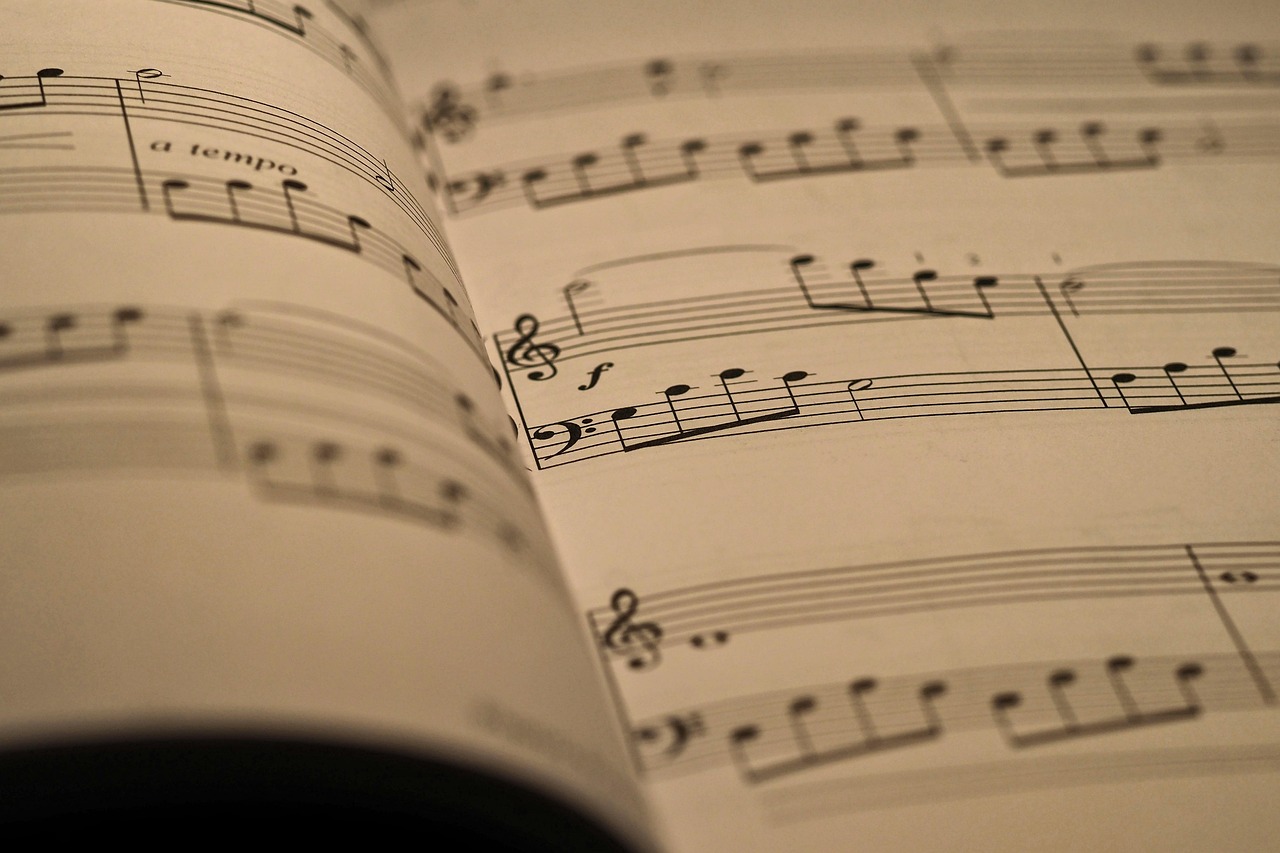
When both clefs are used together, they form the Grand Staff. This is common for piano music. The treble clef is on top. The bass clef is on the bottom. A brace connects them. This allows for a wide range of notes.
Bar Lines and Measures (or Bars)
Music is organized into manageable sections. These sections are called measures, or bars. Thin vertical lines, called bar lines, divide the staff. Each measure contains a specific number of beats. This structure makes music easier to read and play. It also helps us keep time. We use double bar lines to mark the end of a section or piece. This organization is vital. It creates a steady flow.
Understanding Musical Notes: Pitch and Duration
Notes are the core of sheet music. They tell you two vital things. They indicate how high or low a sound is (pitch). They also show how long that sound should last (duration). Let’s explore these elements.
Pitch: How High or Low a Note Sounds
Each note symbol on the staff represents a specific pitch. Pitches are named using the first seven letters of the alphabet: A, B, C, D, E, F, G. After G, the sequence repeats. This is fundamental to understanding melodies. Notes positioned higher on the staff have a higher pitch. Notes lower on the staff have a lower pitch.
To identify notes quickly, use mnemonics. For the Treble Clef:
- Lines: Every Good Boy Does Fine
- Spaces: F A C E
These phrases helped me immensely as a beginner. We encourage all our students to use them.
For the Bass Clef:
- Lines: Good Boys Do Fine Always
- Spaces: All Cows Eat Grass
Practice identifying these notes. It builds muscle memory. Our team always starts here.
Sometimes, notes go beyond the five lines of the staff. For these, we use ledger lines. These are short lines extending the staff. They appear above or below the staff. Ledger lines allow for a much wider range of pitches. They let us write very high or very low notes. I remember feeling clever when I first deciphered them.
Duration: How Long a Note Lasts
The shape of a note determines its duration. This tells you how long to hold the sound. Understanding these shapes is key to rhythm. We often count rhythm to an internal pulse.
- A Whole Note is a hollow oval. It has no stem or flag. It receives four beats in common time. It is the longest standard note.
- A Half Note is a hollow oval with a stem. It gets two beats. It is half the length of a whole note.
- A Quarter Note is a filled-in oval with a stem. It receives one beat. This is often our counting unit.
- An Eighth Note is a filled-in oval with a stem and one flag. It gets half a beat. Two eighth notes are often beamed together.
- A Sixteenth Note is a filled-in oval with a stem and two flags. It receives a quarter of a beat. Four sixteenth notes are usually beamed.
Flags are those little tails on the stems. Beams connect multiple flagged notes together. They make reading groups of notes easier. We tried various methods for teaching duration. Visualizing these shapes proved most effective. Our students quickly grasped the relationships.
Rests: Moments of Silence
Music is not just about sound. It also relies on silence. Rests indicate periods of silence. Each note duration has a corresponding rest symbol. These rests tell you to pause for a specific length of time. They are just as important as the notes themselves. Ignoring rests can ruin the rhythm of a piece.
- Whole Rest: A thick rectangle hanging from the fourth line. It lasts for four beats.
- Half Rest: A thick rectangle sitting on the third line. It lasts for two beats.
- Quarter Rest: A squiggly line resembling a ‘Z’ or a lightning bolt. It lasts for one beat.
- Eighth Rest: A small diagonal line with one flag. It lasts for half a beat.
- Sixteenth Rest: A small diagonal line with two flags. It lasts for a quarter of a beat.
I found rests challenging initially. They felt like an interruption. But they are integral. They provide breathing room and build tension. We emphasize practicing rests just as much as notes.
Decoding Rhythm: Time Signatures and Tempo
Rhythm is the heartbeat of music. It dictates when notes are played and for how long. Two crucial elements define rhythm: time signatures and tempo. We delve into these next.
Time Signatures: The Beat of the Music
A time signature appears at the beginning of a piece. It is after the clef and key signature. It looks like a fraction. The time signature tells us two things. The top number indicates how many beats are in each measure. The bottom number tells us what kind of note gets one beat. This is fundamental for understanding the pulse.
The most common time signature is 4/4. This means there are four beats per measure. A quarter note receives one beat. This is often called “common time.” It feels very natural to count. Many popular songs use 4/4.
Another common one is 3/4. This means three beats per measure. A quarter note still gets one beat. This creates a waltz-like feel. Think of a triple meter dance. My first waltz piece used this.
2/4 means two beats per measure. A quarter note gets one beat. This gives a marching or polka feel. We often simplify counting to “1-2, 1-2.”
Understanding time signatures helps you count accurately. It also helps you feel the music’s pulse. This is essential for playing in time. Our team always starts rhythm exercises with counting the time signature.
Tempo: How Fast or Slow to Play
Tempo indicates the speed of the music. It tells you how fast or slow to play the piece. Composers use various methods to specify tempo. We find this helps capture their intent.
Often, Italian words describe tempo. Common examples include:
- Largo: Very slow
- Adagio: Slow
- Andante: Walking pace
- Moderato: Moderate speed
- Allegro: Fast and lively
- Presto: Very fast
These words convey a mood as well as a speed. I love how descriptive they are.
Composers also use metronome marks. These give an exact tempo. For example, ♩ = 120 means 120 quarter notes per minute. This is a precise speed. A metronome is an invaluable tool for practice. It ensures you maintain a consistent tempo. We strongly recommend using one.
Dots and Ties: Extending Note Duration
Sometimes, notes need to be held longer than their standard duration. Composers use dots and ties for this. They add flexibility to rhythm. We encountered these often in more complex pieces.
A dot placed after a note increases its duration. It adds half of the note’s original value. For example, a dotted half note lasts for three beats. (A half note is two beats, plus half of two beats, which is one beat, totaling three beats.) A dotted quarter note lasts one and a half beats. This simple mark changes timing significantly.
A tie connects two notes of the same pitch. It looks like a curved line. When notes are tied, you play the first note. Then you hold it for the combined duration of both notes. You do not re-attack the second note. Ties are often used to sustain a note across a bar line. They create seamless phrases. We use them for smooth melodic lines.
Dynamics and Expression: Adding Feeling to Your Music
Music is an emotional language. Dynamics and expressive markings convey feelings. They tell you how loudly or softly to play. They also indicate how to shape individual notes. This adds depth and character to your performance. My experience as a musician taught me their importance.
Dynamics: Volume Control
Dynamics refer to the volume of the music. Italian terms and abbreviations indicate these. They guide the player’s intensity. We always strive for expressive playing.
- pp (pianissimo): Very soft
- p (piano): Soft
- mp (mezzo piano): Medium soft
- mf (mezzo forte): Medium loud
- f (forte): Loud
- ff (fortissimo): Very loud
Other markings indicate gradual changes in volume. A crescendo (often marked with <) means gradually get louder. A decrescendo or diminuendo (marked with >) means gradually get softer. These create dramatic effects. They give music its emotional arc. Our performances rely on accurate dynamic interpretation.
Articulations: Shaping Individual Notes
Articulations are symbols that tell you how to play a note. They affect the attack and release of individual sounds. These small marks make a big difference. We often experiment with them.
- A staccato mark is a dot above or below a note. It means play the note short and detached.
- A legato mark is a curved line above or below a group of notes. It means play the notes smoothly and connected.
- An accent mark is a sideways wedge ( > ) above or below a note. It means play the note with emphasis.
These markings bring life to the music. They differentiate a bland performance from an engaging one. I always pay close attention to them.
Other Expressive Marks
Beyond dynamics and articulations, other symbols convey expression. A slur is a curved line connecting different pitches. It means play them smoothly, without re-articulating. This creates a melodic phrase. A fermata is a pause symbol. It tells you to hold a note or rest longer than its written value. The duration is up to the performer or conductor. Repeat signs instruct you to play a section again. There are many more symbols. Each adds a layer of instruction. They are all part of the composer’s message. We interpret them carefully.
Sharps, Flats, and Naturals: Altering Pitch
The seven musical notes (A-G) form the basic palette. However, music often requires notes beyond these. That’s where sharps, flats, and naturals come in. These symbols alter the pitch of a note. They add color and complexity to melodies. I found them tricky at first. They became clear with practice.
Accidentals: Temporary Changes
Accidentals are symbols that temporarily change a note’s pitch. They are placed directly before the note head. An accidental affects only that specific note. It remains in effect for the entire measure. After the measure, the note reverts to its original pitch. We use them for melodic variety.
- A sharp (#) raises a note by one semitone (half step). If you see C#, play the note a half step higher than C.
- A flat (b) lowers a note by one semitone. If you see Eb, play the note a half step lower than E.
- A natural (♮) cancels a sharp or flat. It restores the note to its original pitch.
These accidentals allow for rich harmonic possibilities. They prevent monotony. My early pieces used many accidentals.
Key Signatures: Permanent Changes
Sometimes, sharps or flats apply to an entire piece. This is where key signatures come in. A key signature is a set of sharps or flats. It appears immediately after the clef. It applies throughout the entire piece. Every note on that line or space is affected. Unless an accidental cancels it. Key signatures define the musical key of a piece. They give a piece its overall tonality. We learn to identify them quickly.
For example, if you see one sharp on the F line in the treble clef, every F note in the piece is played as F#. This defines the key of G major or E minor. If you see two flats, on B and E, then every B and E are flatted. This indicates the key of B-flat major or G minor. Understanding key signatures simplifies reading. It prevents repetitive accidental markings. Our team always checks the key signature first.
Practice Strategies for Sheet Music Mastery
Reading sheet music is a skill. Like any skill, it requires consistent practice. We’ve identified several strategies that work. These will help you progress effectively. My own journey relied heavily on these methods.
Start Slow: Never try to play at full speed immediately. Begin at a tempo where you can play every note correctly. Accuracy over speed is paramount. Speed will naturally come later. We always advise this patience.
Use a Metronome: A metronome is your best friend. It provides a steady beat. This helps you develop a strong sense of rhythm. Start slow with the metronome. Gradually increase the tempo as you improve. My personal metronome is well-worn.
Break It Down: Don’t try to read an entire piece at once. Focus on small sections. Master a single measure or a phrase. Then connect these smaller parts. This prevents overwhelm. Our students find this modular approach very effective.
Identify Patterns: Music is full of patterns. Look for repeating note sequences or rhythmic motifs. Recognizing these patterns makes reading faster. Your brain becomes more efficient. We train our eyes to spot them.
Listen to the Music: If possible, listen to a recording of the piece. This helps you understand how it should sound. It reinforces your reading. It also inspires your practice. Our musical instincts are boosted by listening.
Regularity is Key: Short, frequent practice sessions are more effective. They beat long, infrequent ones. Aim for 15-30 minutes daily. Consistency builds lasting skills. My personal practice routine included this.
Common Pitfalls and How to Overcome Them
Learning anything new comes with challenges. Reading sheet music is no exception. We’ve seen common struggles among beginners. Here’s how to navigate them successfully. Our team has faced these too.
Overwhelm: The sheer amount of symbols can feel intimidating.
- Solution: Remember to take it one step at a time. Focus on mastering each basic element. Don’t look too far ahead. We emphasize small, achievable goals.
Rushing Ahead: Eagerness can lead to playing too fast before you’re ready.
- Solution: Always use a metronome. Prioritize accuracy over speed. Speed will develop naturally. Our experience shows this consistency pays off.
Ignoring Theory: Some learners skip understanding the “why.” They only focus on the “what.”
- Solution: Take time to understand the theory behind the symbols. Why are there sharps? What does the time signature mean? Deeper understanding aids recall. We believe theory enhances practical skill.
Lack of Consistency: Sporadic practice yields slow results.
- Solution: Establish a regular practice schedule. Even 15 minutes daily is incredibly beneficial. Small habits create big changes. My consistent practice habits led to breakthroughs.
Fear of Mistakes: Beginners often worry about playing wrong notes.
- Solution: Mistakes are part of learning. Embrace them as feedback. They show you where to improve. Everyone makes them. We all started somewhere.
Remember, every expert musician started exactly where you are now. Your journey is valid. We are here to support you. It takes time and patience.
Congratulations! You’ve taken significant steps towards understanding sheet music. We have explored the staff, clefs, and notes. We also covered rhythm, dynamics, and pitch alterations. Each element is a piece of a beautiful puzzle. This knowledge unlocks a vast world of musical expression. Your dedication will be rewarded. Keep practicing consistently. You are now equipped with the fundamental tools. Go forth and make music. Our journey has shown us that anyone can achieve this. You can do it!