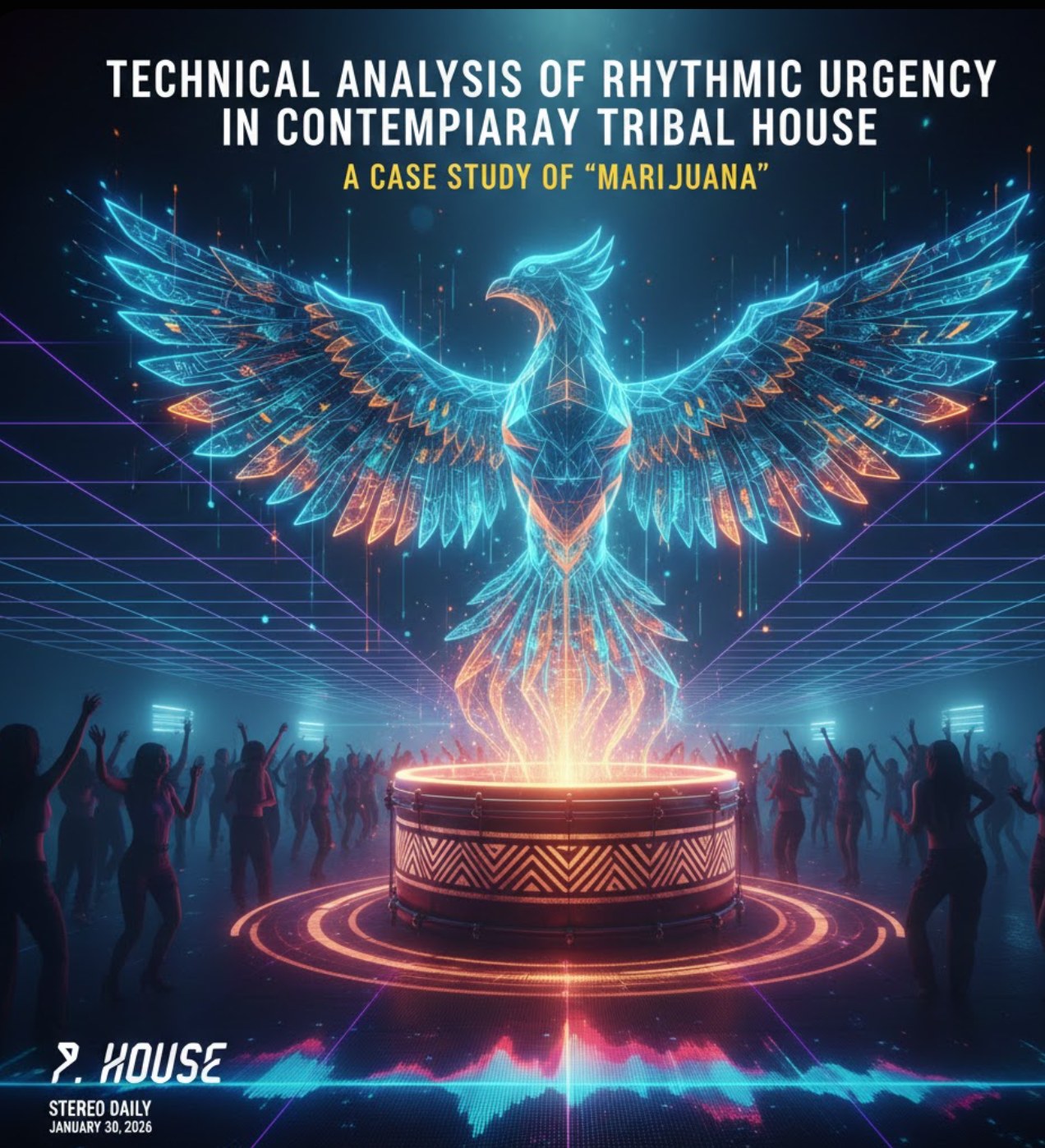

Abstract
This article analyzes the production techniques used to induce movement and “uplifting” emotional responses in listeners within the Latin House sub-genre. Using the track “Marijuana” as a primary case study, we examine the relationship between a 126 BPM tempo, C# Minor tonality, and the implementation of tribal percussion arrays. The research focuses on how sidechain compression and additive synthesis contribute to the “danceability” of modern electronic compositions.
1. Compositional Framework
The track is composed in C# Minor at a steady tempo of 126 BPM. In the context of dance psychology, this tempo falls within the “golden ratio” for synchronized human movement. The choice of C# Minor provides a harmonic depth that allows for “uplifting” melodic structures while maintaining the “darker” energy required for club environments.
2. Sound Design and Synthesis
The primary lead and bass elements were engineered using Serum (Wavetable Synthesis) within the Ableton Live Digital Audio Workstation (DAW).
- Tension Building: Long-form white noise risers were utilized to manipulate acoustic pressure.
- Spatial Processing: Extensive use of Echo and Utility plugins allowed for precise stereo width management, ensuring that the tribal elements occupy a distinct frequency space without masking the lead melody.
3. Rhythmic Methodology and Sidechain Dynamics
The rhythmic foundation utilizes a Tribal House structure, characterized by a high density of percussive layers.
- Dynamic Ducking: To maintain rhythmic clarity, Kickstart 2 was employed for sidechain compression.
- Technical Goal: By attenuating the sub-bass and mid-range frequencies during the kick drum’s transient, a “pumping” effect is achieved. This methodology, inspired by the production styles of artists such as Hugel, is mathematically designed to maximize the perceived loudness and physical impact of the rhythm.
4. Conclusion
The analysis of “Marijuana” demonstrates that the combination of high-density percussion and strategic sidechaining creates a “rhythmic urgency.” This study suggests that listener engagement in Latin House is a direct result of the balance between harmonic tension (C# Minor) and rhythmic release (Tribal percussion).
Author: Play House / Subject: Music Theory / Sound Engineering